Heat sealing fails where food production is messiest: when fat, liquid or powder contaminates the seal area. Ultrasonic sealing forms a reliable seam directly through that contamination, with a tool that stays cold and a cycle that completes in fractions of a second.
How does it work?
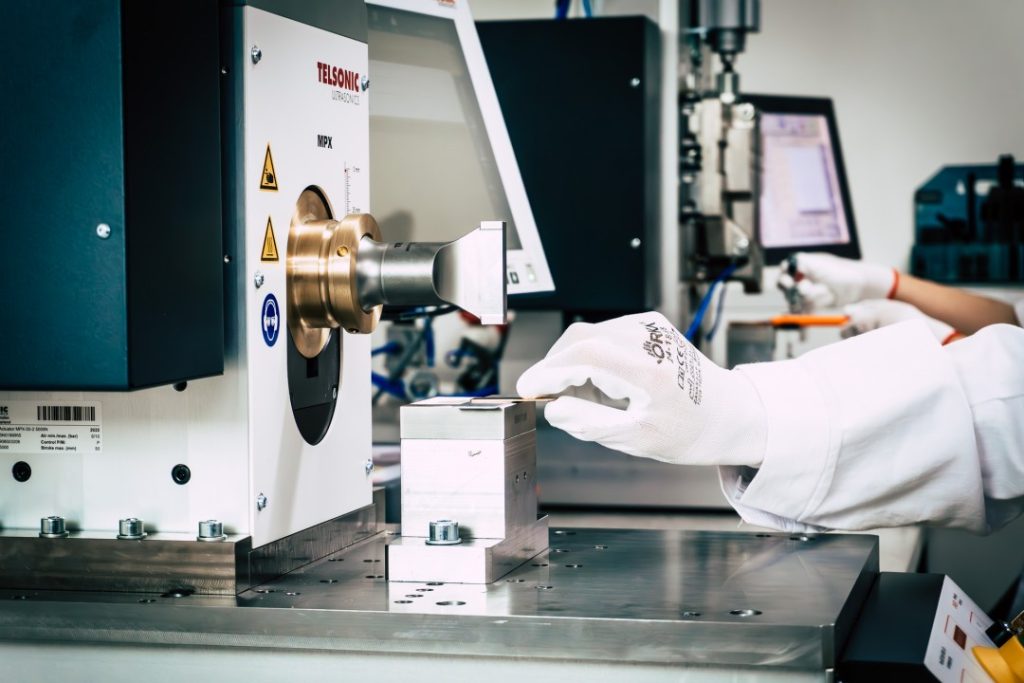
Ultrasonic sealing is a mechanical process, not a thermal one. Vibrations between 20 and 40 kHz are transmitted into the packaging material through a sonotrode under pressure. Friction generates heat precisely at the joint interface; the seam solidifies the moment vibration stops.
What this means in food production:
- Seals through contamination. Vibration displaces product residue out of the seal zone, so fat, liquid or powder in the seam does not cause leaks.
- Cold tooling, no thermal load. No heat reaches the product, and there is no warm-up or cool-down between cycles.
- No consumables. No adhesives or added materials, which simplifies food-contact compliance.
- Verifiable quality. Energy, force and displacement are logged per cycle; out-of-window seals are rejected automatically.
Typical applications: sealing films for sandwich and pastry packaging, portioned meat and cheese packaging, yogurt lids, individual sweet wrappers.
Ultrasonic cutting
A blade vibrating at ultrasonic frequency reduces friction between blade and product. Sticky, soft and layered foods (dough, ice cream, cheese, layered cakes) are cut with clean edges, without deformation or product sticking to the blade. Less residue means shorter cleaning time and longer blade life.
When is ultrasonic technology not the right choice?
- Large sealing surfaces beyond roughly 100 to 150 cm²: energy dissipates, alternative methods become more practical.
- Incompatible materials: the sealing layers must be weldable thermoplastics; some laminates and thermosets do not fuse.
- Seam geometries the sonotrode cannot reach.
Whether your specific film, laminate or product qualifies is an application-level question, and exactly what a laboratory test answers before any investment.
FAQ
Can ultrasonic sealing handle product residue in the seal area? Yes. The vibration displaces fat, liquid or powder out of the seam during the cycle, forming a tight seal where heat sealing would leak.
Does ultrasonic sealing heat the product? No. Heat forms only at the joint interface, for a fraction of a second. The sonotrode stays cold.
Can we test our packaging before buying equipment? Yes. Send film, laminate or product samples to our ultrasonic laboratory. We run trials on your actual materials and return documented seal strength and integrity results.
Test your application in our laboratory
Before you commit to equipment, commit to evidence. Send us your packaging material or product samples and receive measured results, not supplier claims.
We are here for you!
Ready to explore new opportunities? Contact us today to discuss your project requirements. Together, we can achieve precision, efficiency, and reliability in your manufacturing processes.
Follow us on social media: