VIAL Automation, your engineering partner for ultrasonic welding and automation.
Our work does not stop at supplying a welding head. We support clients across the full engineering path, and three stages carry most of the value:
- Design optimisation. Consulting on weld-friendly geometry and joint design before a part is finalised.
- Prototyping. Initial welding trials on our own tooling and machinery.
- Testing and validation. Empirical proof of joint quality before any investment is committed.
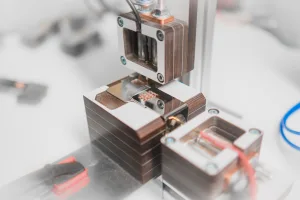
At the centre of this sits our in-house ultrasonic laboratory, where we run R&D on ultrasonic applications, validate joining concepts, and produce documented results that make scale-up clean and predictable. Backed by 27 years of practice and more than 350 projects, we accompany you from joint design and parameterisation through pattern creation to series production.
Most clients reach us with a joining problem before they reach us with a technology:
- An adhesive that cures too slowly for the line speed.
- A soldered contact that fails insulation.
- A bolted busbar that adds resistance.
What ultrasonic welding is
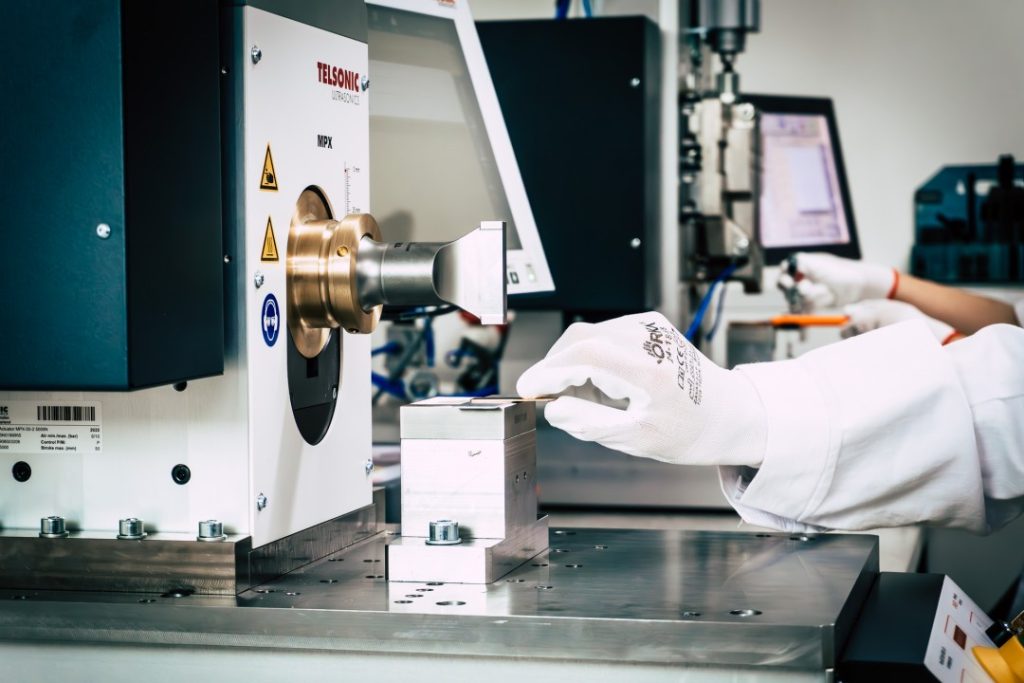
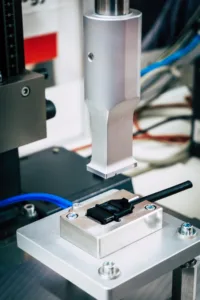
Ultrasonic welding is a solid-state joining process driven by mechanical vibration, with no external heat source, filler, or adhesive. A transducer converts electrical energy into high-frequency vibration (typically 20 to 40 kHz), which a booster amplifies and transmits into the parts through a precision tool called a sonotrode.
- Thermoplastics. The vibration briefly melts the joint interface, which solidifies under hold pressure into a molecular bond.
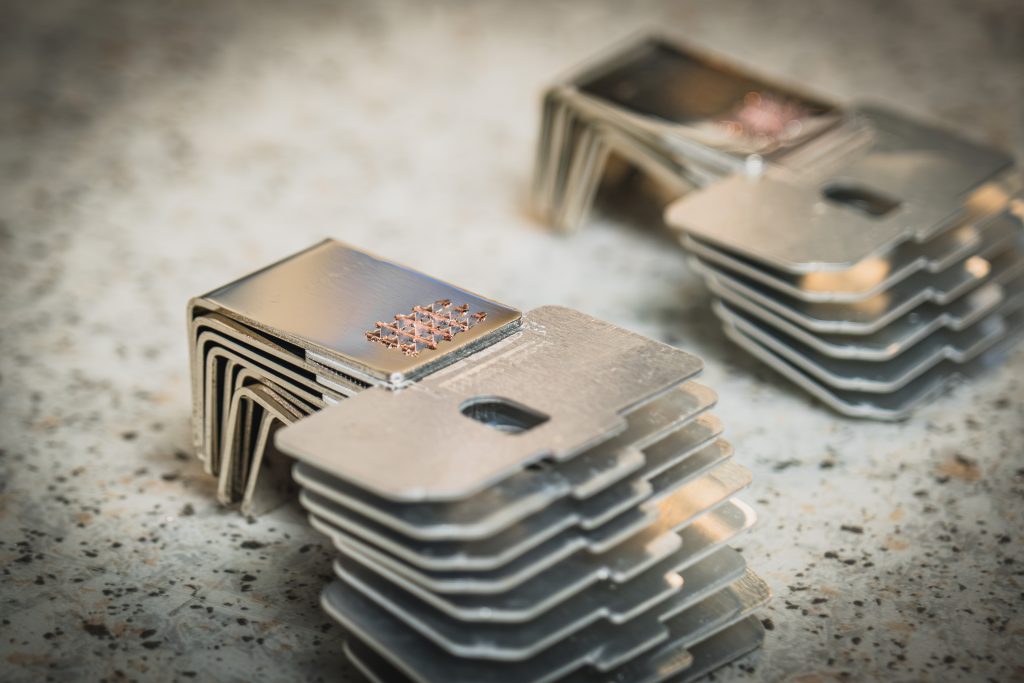
- Metals. The temperature never reaches melting point. The vibration disrupts surface oxides and brings clean metal into contact, forming a metallurgical bond with no heat-affected zone.
In both cases the joint is the same material as the parts. In practice this means:
- Cycle times of roughly 0.1 to 3 seconds per weld.
- No consumables: no adhesives, screws, flux, or shielding gas.
- No heat-affected zone around sensitive components.
- Per-cycle quality data, with weld energy, force, and displacement logged for every joint.
Three misconceptions worth correcting
- “It’s vibration gluing.” There is no adhesive in the process. The bond is the same material as the parts: molecular for plastics, metallurgical for metals.
- “No heat means a brittle weld.” The reverse is true. Because heat stays at the interface and the bulk material never warms, you avoid the heat-affected-zone weakening that fusion welds carry. Material properties are preserved.
- “The quality is hard to verify.” Every weld is measured in real time. Energy, force, displacement, and time are logged per cycle, and tolerance limits can reject a non-conforming weld at the moment it happens, which adhesive joints rarely allow.
A note on limits, because it matters: ultrasonic welding is not the right answer for thermoset plastics, thick metal sections, dissimilar metals with very different hardness, or very large bond areas. We establish that early rather than after tooling.
The ultrasonic laboratory and quality
Our in-house laboratory is equipped with digital microscopy, tensile and pressure testing, and leak testing, supported by a broad range of welding systems, which lets us prove joint quality empirically.
Beyond development, we run contract manufacturing for small-to-medium series, from a handful of test pieces to volume production, including in our ISO 8 cleanroom for medical and pharmaceutical work. Every workpiece is checked and documented, and the quality of each ultrasonic joint is measured and logged, giving you a traceable record rather than an inferred one.
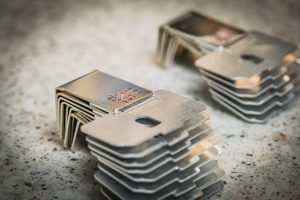
The principle behind all of it is simple: the cheapest way to de-risk a joining decision is to make the first welds in a lab, not on a production line.
Evaluating ultrasonic welding for a specific joint? Send us your material and geometry. We will tell you honestly whether it fits, where the limits are, and what the validated weld looks like.
We are here for you!
Ready to explore new opportunities? Contact us today to discuss your project requirements. Together, we can achieve precision, efficiency, and reliability in your manufacturing processes.
Follow us on social media: