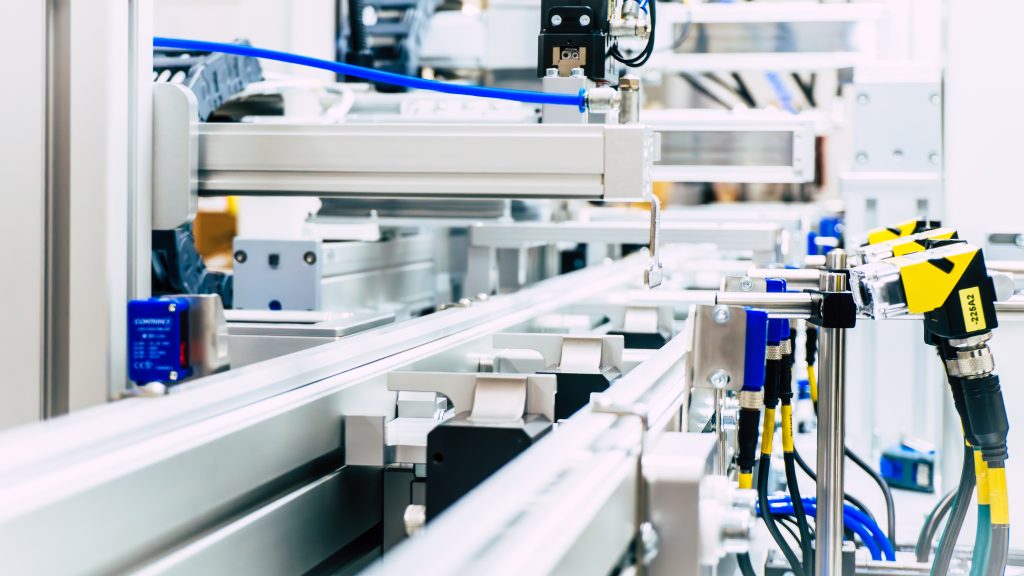
Most automation projects do not fail at the core process. A welding head welds, a press presses, a robot places. Projects fail around the process: in material feeding, in changeover downtime, in the integration points nobody specified precisely enough.
This is the part of machine building we focus on getting right. VIAL Automation develops custom automated machines and production cells, with ultrasonic welding integration as our core engineering discipline. Every machine starts with a direct engineering conversation about the client’s process, not with a standard catalogue configuration.
What we build
Our machine-building work covers three typical scenarios:
- Standalone automated or semi-automated machines for a specific joining, assembly, or processing task
- Integration of ultrasonic welding stations into existing production lines, including handling, indexing, and control integration
- Complete production cells combining robotics, transport systems, and rotary or ring indexing tables
Ultrasonic technology is our primary field of development. Integrating it into automated systems allows clients to replace adhesives, screws, or manual assembly with a joining process that logs weld energy, force, and displacement for every single cycle. Quality stops being an assumption and becomes a per-part data record.
Material flow decides uptime
A machine is only as productive as the material stream feeding it. This is why we develop and build our own peripheral systems for material handling and buffering, and why they appear in most of our automation projects:
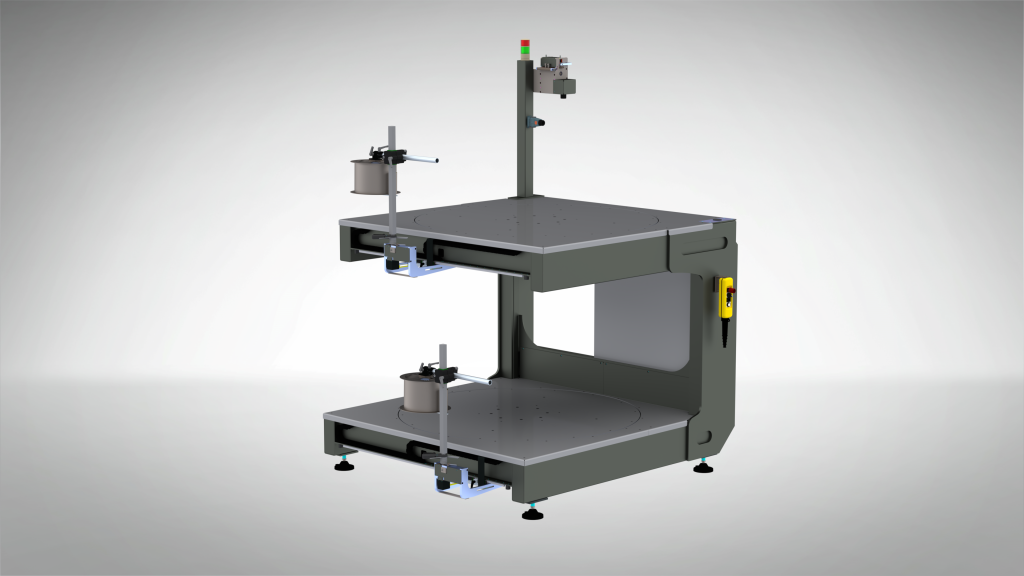
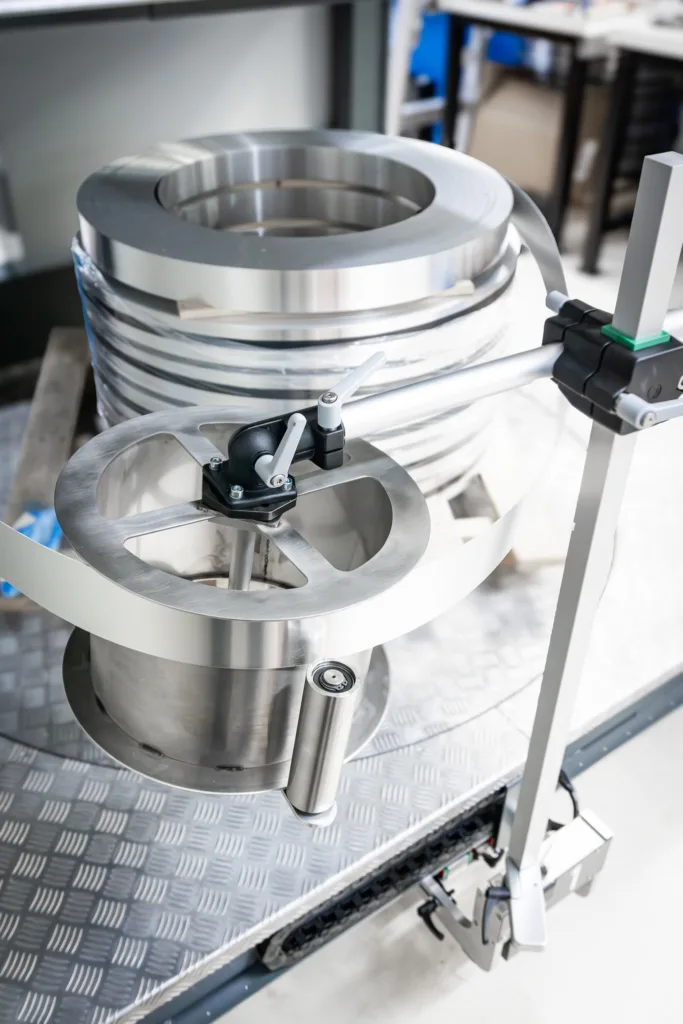
- Reel decoilers (horizontal and vertical). Coiled raw material, such as terminal bands or wire, is fed to the process at a synchronized speed with dancer-controlled tension. Our horizontal decoiler carries palleted coils up to 3,000 kg. The double horizontal variant DH-1500 allows the operator to load a backup reel while the primary reel is feeding the line, which reduces reel-changeover downtime to close to zero.
- Conveyor belt bunker FB-50. A buffer between bulk material and the sorting system. Capacities from 12 to 50 liters and belt widths from 30 to 150 mm let the bunker meter parts into a vibratory feeder instead of overloading it, extending autonomous runtime between operator refills.
- Spring separator. Bulk compression springs entangle during transport. Our electrically driven vibratory separator detangles them and delivers individual springs to the assembly system, removing a manual step that routinely bottlenecks sub-assembly lines.
- Electric foil feeder FV-340. For ultrasonic welding of visible plastic surfaces, the FV-340 advances a protective foil between sonotrode and workpiece before each cycle, preventing tool marks on cosmetic or optical parts. It handles foil widths from 10 to 100 mm and roll diameters up to 340 mm.
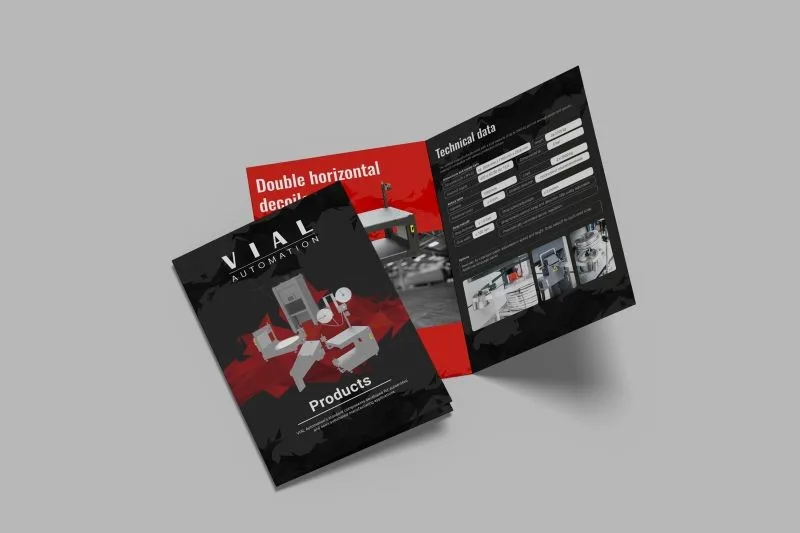
These systems exist because our own projects demanded them. When we design a machine for a client, feeding and buffering are engineered into the concept from day one, not bolted on after the first production stoppages.
Validation before investment
We do not ask clients to commit capital to an unproven process. Our in-house ultrasonic laboratory tests the application first: sample welds, parameter optimization, destructive pull-testing, resistance measurement, and a validation report. Only after the process is proven do we design the machine around it.
This sequence matters most where the risk is highest. In the medical and pharmaceutical sector, where we manufacture and assemble in an ISO 8 cleanroom, process validation is not optional. One of the milestones on this path was an automated machine we built for a Slovenian pharmaceutical manufacturer, a project we documented in an earlier article on the engineering behind it.
Engineered for a longer lifecycle
Sustainability in machine building is not a label we attach afterwards. It is a set of engineering choices we make at the concept stage:
- Modularity and scalability. Our machines are designed so that stations, feeders, and tooling can be extended or reconfigured as production volumes and product variants evolve. The investment stays relevant instead of being replaced.
- A cleaner joining process. Ultrasonic welding requires no adhesives, no solvents, and no consumables. Energy input per weld cycle is measured in joules, which puts it an order of magnitude below resistance or laser welding.
- Recyclability by design. Welded thermoplastic assemblies remain a single material type and enter the recycling stream as the polymer they are, not as an adhesive-contaminated composite.
Our environmental management system is certified to ISO 14001, alongside ISO 9001 for quality.
Where to start
If you are evaluating automation of a joining or assembly process, the practical first step is not a machine quotation. It is a feasibility conversation with our engineers and, where ultrasonic welding is involved, a test in our laboratory.
Send us your part geometry, material specification, and target volumes. We will tell you honestly whether the process is viable, and what the machine around it should look like.
Contact us at info@vial-automation.si or through the contact form on our website.
We are here for you!
Ready to explore new opportunities? Contact us today to discuss your project requirements. Together, we can achieve precision, efficiency, and reliability in your manufacturing processes.
Follow us on social media: